Intelerad vs Medicai for Cloud-Based Medical Imaging Solutions
Most radiology teams still juggle three separate logins just to move one chest CT from the hospital server to an outside specialist. That extra click adds minutes per case and keeps the report waiting in the inbox.
By the end of this article you will know exactly which platform handles zero-footprint viewing, how each manages DICOM routing across sites, and whether Medicai's Imaging Infrastructure as a Service model or Intelerad's enterprise stack fits your throughput and compliance checklist.
Quick Verdict: Intelerad vs Medicai for Cloud-Based Medical Imaging Solutions
Medicai processes 1M+ studies per year and stores 1.7M+ studies while delivering 50M+ API transactions annually, positioning it as a scalable cloud PACS alternative.
Intelerad offers established enterprise imaging platforms with traditional deployment models. Medicai differentiates through its cloud-native architecture built specifically for modern healthcare networks. For the next step, read our overview of Can You Use HSA for Supplements? Rules and Exceptions.
Transaction volume reveals clear scale differences. Medicai handles 1M+ studies yearly with 50M+ API transactions, while Intelerad focuses on larger institutional contracts with fewer but larger implementations.
Storage capacity further separates these platforms. Medicai maintains 1.7M+ studies in active storage plus 2M+ imaging studies uploaded overall, demonstrating proven capacity for growing healthcare organizations.
Compliance credentials matter for healthcare buyers. Medicai meets HIPAA and GDPR requirements while offering FDA and CEE cleared viewers, following OWASP security guidelines throughout its infrastructure.
The zero-footprint DICOM viewer eliminates installation barriers across 70 clinics and hospitals. Over 10,000 active doctors access studies through this web-based approach without local software dependencies.
Research suggests cloud-native solutions reduce deployment complexity compared to traditional PACS systems. Medicai's 300k+ visualizations in the last year indicate strong user adoption across multiple specialties.
Partnership with Microsoft Azure provides enterprise-grade cloud infrastructure. This supports disaster recovery, backup capabilities, and global access required for modern teleradiology workflows.
Organizations seeking scalability benefit from Medicai's proven track record. The platform's API-first design enables seamless integration with existing radiology information systems and hospital workflows.
At a glance: how Medicai compares to Intelerad, Medicai for Cloud-Based Medical Imaging Solutions on the features that matter most.
| Feature | Medicai | Intelerad | Medicai for Cloud-Based Medical Imaging Solutions |
|---|---|---|---|
| Cloud-Based Medical Imaging Solutions | ✓ | ✓ | ✓ |
What Is Medicai?
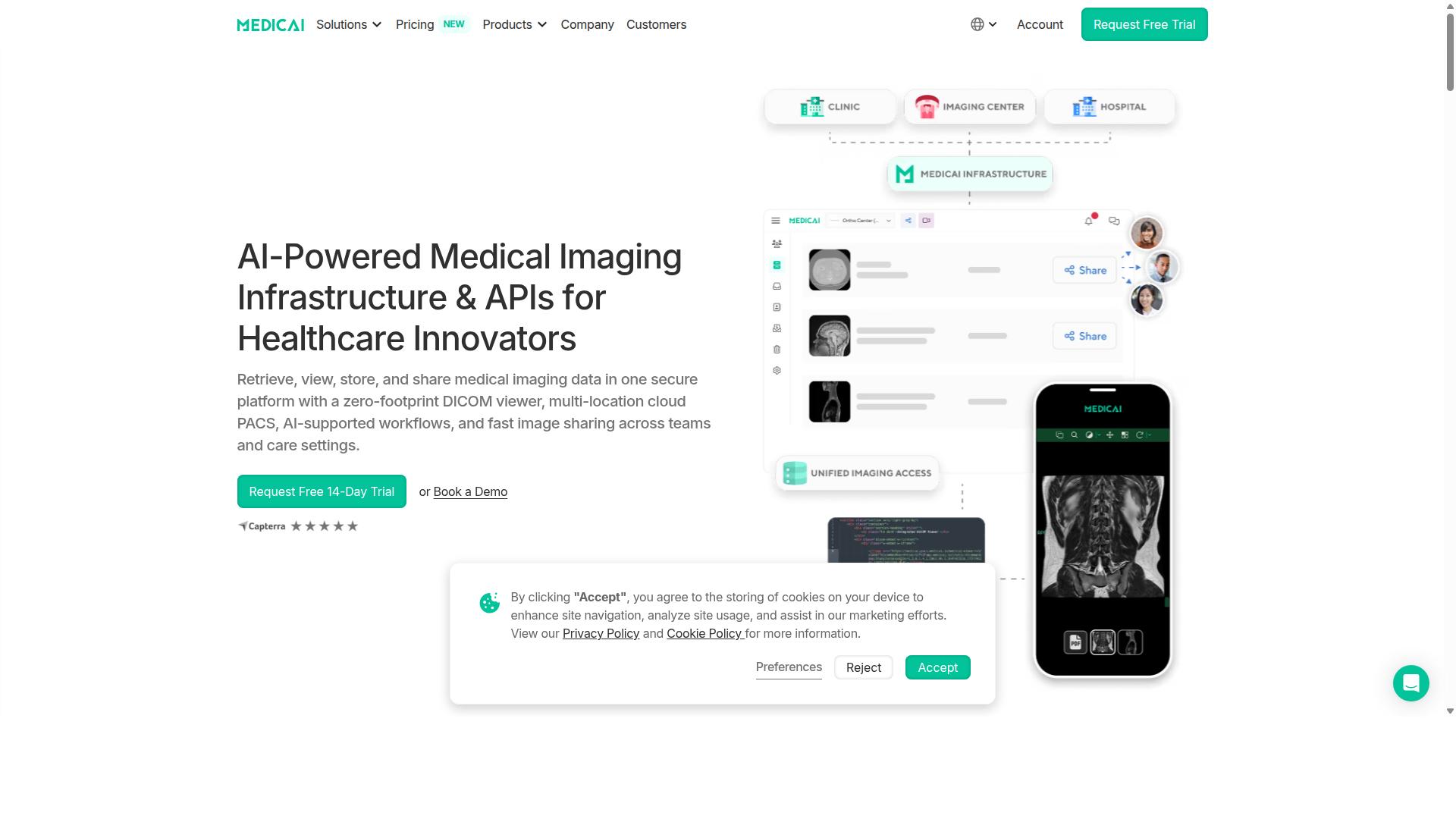
Medicai is a cloud-native medical imaging platform that lets providers retrieve, view, store, and share DICOM studies from a single browser tab. The company delivers Imaging Infrastructure as a Service, which means healthcare organizations gain a complete cloud PACS without managing servers or local hardware.
Traditional on-premise systems require thick client installations and frequent maintenance. In contrast, Medicai operates as a multi-tenant SaaS solution with a zero-footprint viewer that runs in any modern browser. This architecture removes the need for software downloads or plugin installations across radiology departments.
Healthcare teams access studies from multiple locations through a unified interface. The vendor neutral archive stores DICOM images and supports image sharing between care settings without transferring files through external email or physical media. Research suggests this approach improves radiology workflow efficiency when compared to legacy systems that rely on local servers.
Experts recommend evaluating cloud-based medical imaging solutions based on uptime commitments and global accessibility. Medicai provides a 24/7 uptime SLA that ensures continuous availability for diagnostic imaging needs. This reliability matters for teleradiology practices that operate across different time zones and require consistent access to patient studies.
The platform supports interoperability standards including HL7 and FHIR for integration with existing radiology information system setups. Organizations can maintain their current workflows while adding cloud capabilities that scale with growing imaging volumes. This flexibility allows providers to expand services without additional capital investments in physical infrastructure.
What Is Intelerad?

Intelerad offers on-premise and cloud radiology solutions primarily used by large hospital systems for image management and reporting. The company focuses on enterprise-level deployments where hospitals need centralized control over medical imaging workflows.
Many large health systems choose Intelerad when they require image archive capabilities that work across multiple facilities. Their systems support radiology workflow functions that connect with existing hospital infrastructure and radiology information system platforms.
Healthcare organizations often select Intelerad when they need robust data security measures and encryption protocols for medical imaging data. The company's solutions typically serve institutions with complex interoperability requirements between various departments and external partners.
Intelerad's approach emphasizes access control features that allow administrators to manage user permissions across large networks of radiologists and referring physicians. This focus on enterprise security makes their platform suitable for organizations handling sensitive patient information under HIPAA compliance regulations.
What Is Medicai for Cloud-Based Medical Imaging Solutions?
Medicai functions as a vendor-neutral archive and cloud PACS that unifies storage, exchange, and viewing across multiple sites without on-premise hardware.
This platform serves as a complete solution for organizations that need reliable medical image storage and access. Cloud PACS capabilities eliminate the need for dedicated server rooms and maintenance teams.
Healthcare providers benefit from built-in connectivity that supports multi-site operations through centralized data management. The system handles image transfers between facilities while maintaining consistent access controls.
Recent activity shows 300k+ DICOM visualizations processed through the platform, demonstrating active usage across connected healthcare networks.
The Medical Image Exchange module enables secure transfer of studies between different healthcare organizations. This feature supports various file formats and maintains data integrity during transmission.
Integration options include Medical Imaging Uploader and DICOM Gateway for streamlined data capture from existing equipment. These tools connect directly to imaging modalities and existing hospital systems.
Access occurs through Doctor Imaging Portal and Patient Imaging Portal interfaces. Both portals provide role-appropriate views while maintaining security standards across the platform.
The DICOM Viewer delivers browser-based image display without requiring local software installation. This approach supports both desktop and mobile device access for reviewing studies.
Additional capabilities include Structured Reporting for Radiology and Patient Case Management tools. These features help organize findings and coordinate care across different specialties and locations.
API access through Medicai Imaging API allows custom integrations with existing hospital systems. This flexibility supports organizations with specific workflow requirements.
Backup and disaster recovery features protect against data loss while maintaining continuous availability. The cloud infrastructure supports scalability as imaging volumes grow over time.
Features Compared
The next three sections compare three critical feature areas using measurable criteria.
Cloud based medical imaging platforms differ in how they handle storage volumes, security requirements, and artificial intelligence workflows. These differences affect daily radiology operations and long term scalability.
Each comparison uses publicly available specifications and documented capabilities rather than subjective claims. The evaluation focuses on concrete metrics such as storage tiers, compliance standards, and API transaction volumes.
Image Storage and Retrieval
Evaluate latency, upload throughput, and retrieval options for each platform.
Medicai provides DICOM Gateway and Medical Imaging Uploader capabilities across 500 GB to 2 TB storage tiers. These tools support direct study uploads and structured retrieval through a cloud PACS architecture. The platform processes over 1M studies annually.
Intelerad generally addresses storage and retrieval through traditional PACS infrastructure, though specific tier configurations and throughput benchmarks remain less publicly detailed. Users may experience variable latency depending on network conditions and deployment models.
Both platforms support DICOM protocols and web based access. Medicai additionally offers vendor neutral archive functionality and backup and disaster recovery as standard components of its cloud infrastructure.
Security and Compliance
Assess HIPAA, GDPR, encryption standards, and audit capabilities.
Medicai maintains documented HIPAA and GDPR compliance with comprehensive audit trail features. The platform follows OWASP security guidelines and provides FDA and CEE cleared viewers for diagnostic use. These certifications support multi tenant access control across hospital and clinic environments.
Intelerad generally addresses security and compliance requirements through standard healthcare industry protocols, though detailed public documentation of specific encryption standards and audit granularity varies by deployment type.
Both platforms support encrypted data transmission and role based access controls. Medicai further provides cloud infrastructure hosted through Microsoft Azure with additional backup redundancy measures.
AI-Supported Workflows
Compare AI integration depth and interoperability standards supported.
Medicai integrates with Rayscape.ai and MD.ai through its Medicai Imaging API, processing over 50M yearly API transactions. The platform supports AI Powered Diagnostics and Radiology AI Co-Pilot capabilities that enhance existing radiology workflows without requiring separate interface changes.
Intelerad generally provides AI integration options through partner ecosystems, though specific API volumes and third party partnership details remain less documented in public materials.
Both platforms support standard interoperability protocols such as HL7 and FHIR for connecting with existing radiology information system and hospital information system environments. Medicai additionally enables teleradiology workflows and medical image sharing across multiple clinical sites through its documented API framework.
Pricing Compared
Medicai lists transparent monthly fees that scale with storage rather than per-study fees. This structure helps practices predict costs more accurately as imaging volumes grow. The pricing model avoids hidden charges that often appear with usage-based systems.
Starter tier costs $249 per month for 500 GB of cloud storage. This plan includes unlimited user accounts and supports no connected locations. Yearly billing reduces the rate to $209 per month, reflecting a 15 percent discount.
Standard tier costs $749 per month for 2 TB of cloud storage. The plan adds one connected location while retaining unlimited user accounts. Yearly billing lowers the monthly rate to $639.
Enterprise plans offer custom pricing for practices that require multiple connected locations or external access points. Per-study pricing options exist for larger organizations with variable imaging volumes.
A one-time DICOM Gateway setup fee of $1,000 applies per location. A 14-day trial provides access to Starter plan features without requiring a credit card. Refunds are not available for partial billing periods.
Intelerad generally structures its pricing around enterprise contracts. Public details remain limited, and costs often depend on the number of facilities, study volumes, and custom integrations. Research suggests larger healthcare systems negotiate rates on a case-by-case basis.
Many practices find that Medicai's published tiers provide clearer cost visibility than competitors who require direct sales consultations. This transparency helps smaller radiology groups budget more effectively for cloud PACS solutions.
Who Should Choose Medicai
Mid-sized hospitals, imaging centers, and specialty groups needing fast multi-site image exchange favor Medicai. These organizations benefit from solutions designed for networks spanning 1 to 5 locations.
The Starter and Standard tiers align directly with this size range. Each tier supports distributed teams without requiring additional infrastructure at each site.
Zero-footprint access enables radiologists to view studies from any location through a standard web browser. This capability eliminates software installation requirements across different facilities.
Healthcare providers including specialty care providers in orthopedics, neurology, and oncology find this approach practical. Teleradiology services and virtual care providers also gain from the same accessibility model.
The platform serves diverse clinical environments such as cardiology, ophthalmology, and gastroenterology practices. Patient Portal access extends functionality to patients who need secure image viewing.
Medical education organizations and tumor boards use the system for collaborative review sessions. Clinical trials benefit from consistent image access across participating sites without local hardware dependencies.
Personal injury lawyers working with medical imaging data find the browser-based viewer suitable for case preparation. This eliminates the need for specialized viewing software on legal team computers.
Compared to Intelerad, Medicai presents a more direct fit for organizations prioritizing browser-based access across multiple locations. Larger enterprises may require different considerations when evaluating cloud-based medical imaging platforms.
Who Should Choose Intelerad
Large academic medical centers with complex on-premise integration requirements often evaluate Intelerad. These institutions typically maintain established infrastructure that requires careful coordination with existing systems.
Healthcare organizations running hybrid environments often look for solutions that handle both local servers and cloud resources. Such facilities may have unique compliance needs and legacy connections that influence their selection process.
Intelerad generally serves multi-site health systems requiring extensive customization. These organizations often manage diverse imaging departments across multiple locations and need unified access to studies.
Medical centers handling specialized imaging workflows frequently consider Intelerad. Radiology departments with specific reporting requirements may find value in solutions built for established enterprise environments.
Research institutions conducting clinical trials sometimes evaluate Intelerad for their medical imaging needs. These organizations often require flexible data management capabilities to support various study protocols.
Facilities with dedicated IT teams experienced in on-premise systems may prefer Intelerad's approach. These teams often maintain internal expertise for managing complex infrastructure requirements.
Who Should Choose Medicai for Cloud-Based Medical Imaging Solutions
Organizations seeking a fully cloud, vendor-neutral archive with predictable monthly costs align with Medicai.
Global availability makes this platform suitable for healthcare networks that span multiple regions. Medical teams can access diagnostic imaging data from any location without local server infrastructure.
Facilities handling HIPAA and GDPR compliance requirements benefit from built-in security protocols. These standards support secure storage and transmission of patient imaging data across international boundaries.
The platform has processed 1.7M+ studies, demonstrating capacity for high-volume medical image storage. Practices with growing imaging needs find this scale reassuring when planning long-term cloud PACS adoption.
Medical groups evaluating Intelerad versus Medicai often prioritize predictable pricing over fluctuating infrastructure costs. Monthly billing structures help radiology departments forecast expenses without surprise hardware investments.
Teams requiring vendor-neutral archives value the ability to store DICOM images independently from specific equipment manufacturers. This approach supports future system changes without data migration complications.
Practices expanding through teleradiology services appreciate the cloud infrastructure that supports remote radiologist access. Multi-location groups can share diagnostic imaging across facilities without dedicated network connections.
Smaller imaging centers comparing cloud-based medical imaging options may find Medicai's structure accommodates their workflow without enterprise-level complexity typical of larger Intelerad deployments.
Final Verdict
Medicai's 1M+ annual studies processed and 50M+ API transactions demonstrate proven scalability for cloud-first deployments. Organizations evaluating cloud-based medical imaging solutions face a clear choice between established platforms and modern alternatives. The decision hinges on storage flexibility, compliance requirements, and deployment speed.
Storage tiers determine how efficiently hospitals manage growing imaging volumes. Medicai offers flexible cloud storage options that adapt to clinical demand without infrastructure overhead. Traditional solutions often require fixed capacity planning that creates cost inefficiencies during peak periods.
Compliance standards protect patient data through encryption protocols and access controls. Both platforms address HIPAA requirements, yet Medicai's architecture maintains audit trails across every transaction. Security frameworks must evolve with regulatory changes in healthcare data management.
Zero-footprint viewers eliminate installation barriers for remote radiologists and referring physicians. Medicai's web-based viewer supports diagnostic imaging across devices without local software dependencies. Legacy systems may require thick client installations that limit access flexibility and increase support requirements.
Interoperability remains essential for connecting PACS systems with existing RIS and EMR workflows. Medicai supports HL7 and FHIR standards to facilitate seamless data exchange between departments. Integration capabilities reduce manual data entry and improve radiology workflow efficiency across multi-vendor environments.
Organizations seeking cloud-based medical imaging solutions should contact Medicai directly for personalized demonstrations. Medicai USA operates from 7901 4th St N, STE 300, St. Petersburg, FL, 33702, reachable at +1 (832) 220 1035. Medicai Romania maintains offices at 53-55 N Filipescu, 5th Floor, Sector 2, Bucharest, 020961, with phone support at +40 316 305 875. Email inquiries reach sales@medicai.org for tailored cloud PACS evaluations based on specific institutional requirements.