What Is the Klow Peptide Blend? GHK-Cu, TB-500, BPC-157 and KPV Explained for Researchers
Four peptides get studied together more often than the label on any single vial suggests. GHK-Cu, TB-500, BPC-157 and KPV each act on different pathways, which is exactly why researchers keep pairing them in the same protocol. Knowing what each one does changes how you read a blend.
This article breaks down the Klow Peptide Blend component by component, then covers Kovagen's formulation, its per-batch independent lab testing, and what a certificate of analysis should tell you. By the end you can judge whether the blend fits a research design and how to verify purity before ordering.
What Is Kovagen (KOVA)?
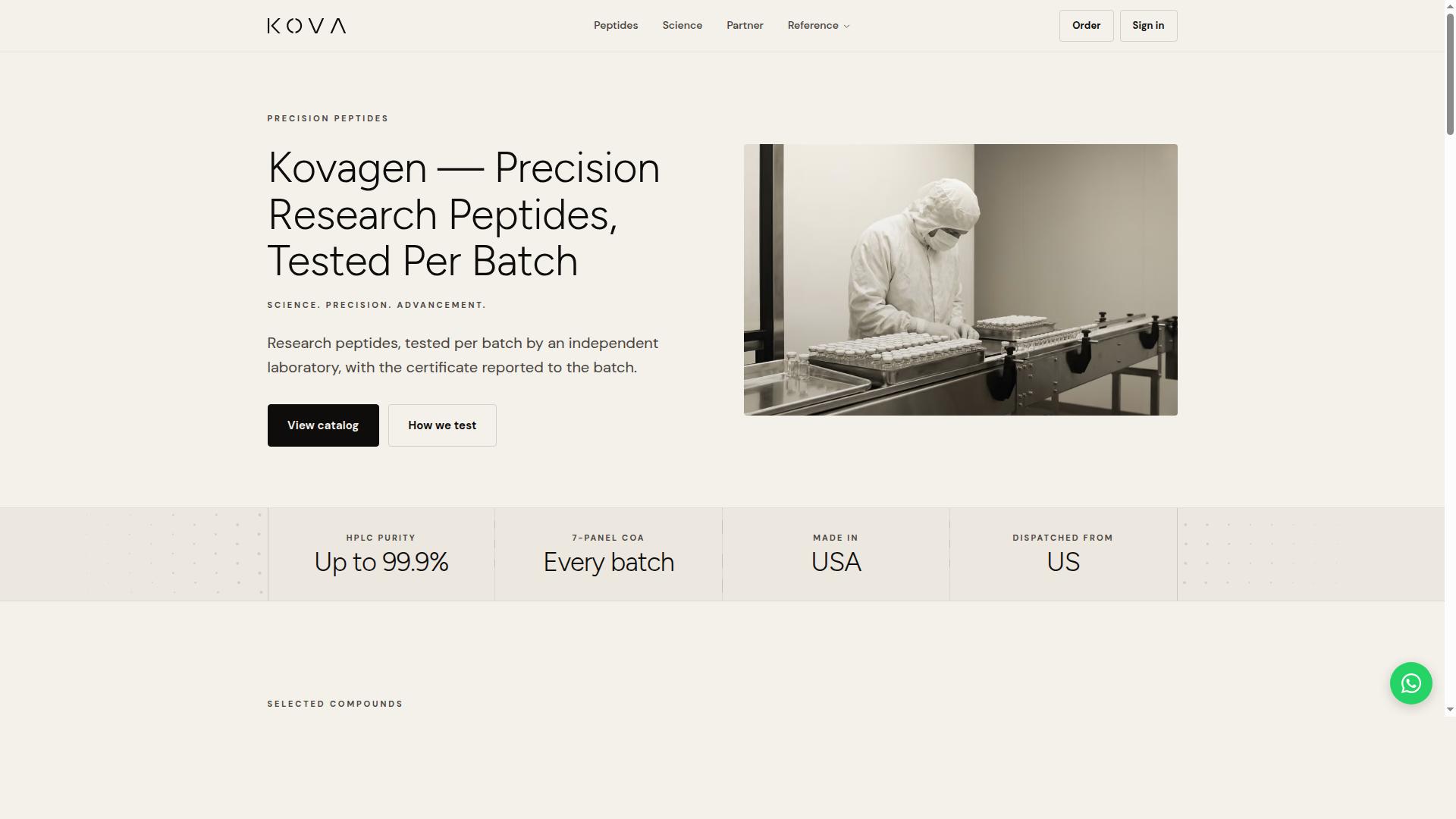
Kovagen (KOVA) is a research peptide supplier that ships to the United States and Canada, offering lyophilized peptides tested per batch by an independent analytical laboratory. The brand operates under the company Hybrid Tech Rainbows LLC, with headquarters in Sheridan, WY. Its approved short description, "Precision Research Peptides, Tested Per Batch," sums up how the company positions itself in a crowded field.
For researchers working with compounds such as the Klow peptide blend, GHK-Cu, TB-500, BPC-157 and KPV, batch-level testing is a meaningful differentiator. Kovagen builds its identity around that idea rather than around volume or variety alone. The brand's stated motto, "Science. Precision. Advancement.", reflects the same emphasis.
Kovagen frames its whole approach around a single principle: evidence is the product. That positioning matters in peptide research, where documentation and analytical verification often carry as much weight as the material itself. The company presents itself as a supplier for laboratory work first, not as a general retailer.
Every material Kovagen supplies is designated for laboratory research use only. The brand is explicit that its products are not intended for human or veterinary consumption. Researchers ordering from KOVA should treat this as a defining part of the brand's identity, not a formality buried in fine print.
In short, Kovagen (KOVA) positions itself as a testing-focused, research-only peptide supplier serving labs across the United States and Canada. Its Sheridan, Wyoming base, its parent company Hybrid Tech Rainbows LLC, and its per-batch testing model together define a clear and consistent brand identity.
What Is the Klow Peptide Blend? GHK-Cu, TB-500, BPC-157 and KPV Explained
The Klow peptide blend combines four distinct research peptides-GHK-Cu, TB-500, BPC-157, and KPV-each with unique biochemical properties studied in preclinical models. Rather than a single compound, Klow is a multi-peptide formulation that brings these four agents together in one research preparation.
Like all research peptides, the blend is intended for laboratory research use only. It is not a therapeutic product, and the studies referenced throughout this section are preclinical in nature, drawn from in vitro and animal model work rather than human trials.
Each component operates through a different mechanism of action. GHK-Cu binds copper and influences gene expression, TB-500 interacts with actin dynamics, BPC-157 acts on growth factor and inflammatory pathways, and KPV is studied for its anti-inflammatory properties. Because these pathways differ, researchers often examine them together for potential complementary effects.
Kovagen stocks this blend as a lyophilized powder under the name Klow (GHK-Cu / TB-500 / BPC-157 / KPV) 50/10/10/10, alongside single-compound versions and related formulations. The four subsections below break down each peptide's structure and the research surrounding it.
GHK-Cu: Copper-Binding Tripeptide
GHK-Cu is a copper-binding tripeptide (glycyl-L-histidyl-L-lysine) that has been investigated for its role in collagen synthesis, angiogenesis, and tissue remodeling in in vitro and in vivo studies. Its short amino acid sequence and low molecular weight make it a compact but biologically active research subject.
The peptide has a high affinity for copper ions, and it is typically studied as a copper complex rather than the bare tripeptide. This copper-binding property is central to how GHK-Cu is examined in regenerative medicine research.
Key preclinical findings include:
- Stimulation of collagen and glycosaminoglycan production in connective tissue models
- Antioxidant effects observed in cell culture systems
- Modulation of gene expression across multiple pathways
Research is usually conducted using lyophilized powder reconstituted with bacteriostatic water. This handling approach supports peptide stability during storage and experimental use. Kovagen lists GHK-Cu as a standalone compound and as a component of both the Klow and Glow blends.
TB-500 (Thymosin Beta-4 Fragment)
TB-500 is a synthetic fragment of thymosin beta-4, a protein known for regulating actin polymerization and promoting cell migration in wound healing research. The fragment corresponds to a 7-amino-acid sequence tied to the actin-binding domain of the parent protein.
Its studied mechanisms center on sequestration of actin monomers, which researchers believe influences how cells move and reorganize. This activity is linked to potential roles in angiogenesis and extracellular matrix remodeling.
Common research models for TB-500 include:
- In vitro scratch assays to measure cell migration rates
- In vivo tissue repair models examining structural recovery
- Angiogenesis studies focused on new vessel formation
All of this work sits firmly within preclinical research and does not establish clinical outcomes. Kovagen stocks TB-500 as a long-chain Thymosin Beta-4 product and within the Wolverine (BPC-157 / TB-500) 10/10 blend, as well as the Klow formulation.
BPC-157: Body Protection Compound
BPC-157, or body protection compound, is a pentadecapeptide derived from a gastric protein and studied extensively for its effects on tissue repair and anti-inflammatory pathways in preclinical models. Its 15-amino-acid sequence (GEPPPGKPADDAGLV) is notable for high stability in gastric acid.
Research findings point to acceleration of wound healing and modulation of growth factors such as VEGF and EGF. Studies also describe effects on fibroblast proliferation and angiogenesis, both central to tissue repair research.
Experimental work often uses lyophilized powder reconstituted for subcutaneous administration in animal models. As with the other components, this remains laboratory research rather than clinical evidence.
BPC-157 appears widely across the Kovagen catalog, including the Wolverine blend, the Regeno (Cartalax / BPC-157 / TB-500) 10/10/10 formulation, and the Klow blend itself. Researchers comparing single compounds with combination preparations can find both formats stocked as lyophilized powder.
KPV: Anti-Inflammatory Tripeptide
KPV (Lys-Pro-Val) is a tripeptide fragment of alpha-melanocyte-stimulating hormone (-MSH) that has been investigated for its anti-inflammatory properties in cell and tissue models. Its amino acid sequence is short: lysine, proline, and valine. This compact structure corresponds to the C-terminal end of -MSH, and researchers often study it as the minimal sequence linked to that hormone's anti-inflammatory activity.
The small size of this tripeptide makes it a practical subject for peptide research. Its defined amino acid sequence and low molecular weight are useful when investigators design controlled experiments and compare activity across related fragments.
Several mechanisms have been explored in the literature. Research suggests KPV may act through the following pathways:
- Inhibition of NF-B signaling, a central regulator of inflammatory gene expression
- Reduction of pro-inflammatory cytokines in stimulated cell cultures
- Effects on keratinocyte function, including responses relevant to barrier repair
- Modulation of immune cell activity in experimental settings
In in vitro studies, KPV is often applied to keratinocyte and immune cell cultures to examine cytokine output and signaling changes. In in vivo studies, preclinical models have been used to explore its wound healing research and inflammation-resolution potential. These are early-stage findings, and results in animal models do not establish effects in humans.
As with other research peptides, KPV is supplied for laboratory investigation only. It is not a therapeutic product, and this material is intended strictly for research use only.
Why These Four Are Studied Together
Researchers often combine GHK-Cu, TB-500, BPC-157, and KPV in preclinical studies to explore potential synergistic effects across multiple pathways involved in tissue repair and inflammation resolution. The rationale is mechanistic: each peptide has been linked to a different stage or process in the repair cascade.
Viewed together, the four components cover complementary territory:
- GHK-Cu (copper peptide): associated with collagen synthesis and extracellular matrix remodeling
- TB-500 (thymosin beta-4 fragment): studied for cell migration and actin-related cytoskeletal dynamics
- BPC-157 (body protection compound): investigated for angiogenesis and tissue repair signaling
- KPV: explored for anti-inflammatory peptide activity and cytokine modulation
The theoretical appeal is that inflammation control, new blood vessel formation, cell migration, and matrix rebuilding are all needed for coordinated repair. A formulation that touches several of these processes at once is therefore an attractive subject for preclinical research.
It is important to note that the Klow peptide blend is a research formulation, not a therapeutic product. Evidence for synergy among these peptides is limited, and interactions between them remain under investigation. Combination studies in the literature are largely early-stage, and researchers should treat proposed synergies as hypotheses to be tested rather than established facts.
For laboratory work, the blend is typically handled as a lyophilized powder and prepared by reconstitution, often with bacteriostatic water. Questions of peptide stability and handling matter when designing reproducible experiments. All four components are supplied for research use only, and any subcutaneous administration or other use outside controlled laboratory settings falls outside their intended purpose.
Kovagen's Klow Blend: Composition, Pricing and Testing
Kovagen offers the Klow blend as a lyophilized powder comprising GHK-Cu, TB-500, BPC-157, and KPV, with pricing and batch-specific testing information available on the product page. The catalog lists the blend as Klow (GHK-Cu / TB-500 / BPC-157 / KPV) 50/10/10/10, a ratio that tells researchers the relative amount of each component in the vial.
That four-part makeup brings together a copper peptide, a thymosin beta-4 fragment, a body protection compound, and the Lys-Pro-Val tripeptide in one preparation. For peptide research teams comparing repair-related pathways, a single blended vial can simplify handling compared with ordering and reconstituting four separate compounds.
The Klow blend sits within a broader catalog of 30 compounds: 22 single peptides and blends. Kovagen stocks these research peptides as lyophilized powder, a format chosen for stability during storage and shipping. Blends in the lineup include Wolverine (BPC-157 / TB-500) 10/10 and Glow (GHK-Cu / TB-500 / BPC-157) 50/10/10, which let labs compare simpler two- and three-component mixes against the four-part Klow formula.
Pricing across the catalog gives a sense of where the Klow blend fits. All prices are in USD, and the examples below reflect listed amounts for selected compounds:
- Retatrutide (GLP-3): from $95.00
- BPC-157 10mg: $80.00
- GHK-Cu: from $55.00
- Wolverine (BPC-157 / TB-500) 10/10: $140.00
- TB-500 10mg: $85.00
These figures show how component count affects cost. A single compound such as GHK-Cu sits at the lower end, while a two-peptide blend like Wolverine carries a higher price. Researchers budgeting for the Klow blend can use these examples as a reference point when planning a purchase.
Every batch is tested by an independent laboratory, and certificates are retrievable by batch number. That means a researcher receiving a Klow vial can match it to the documentation for that specific lot rather than relying on a generic product claim. Batch-level traceability matters in preclinical work, where reproducibility depends on knowing exactly what was in the vial.
For labs weighing the Klow peptide blend against separate purchases, the combination of a defined four-component ratio, lyophilized presentation, and batch-linked certificates makes it a practical option within Kovagen's stocked range. The product page carries the current price and the testing record tied to each lot.
Trust Signals: Batch Testing and Certificates of Analysis
Kovagen emphasizes transparency by having every batch of research peptides tested by an independent analytical laboratory, with certificates of analysis (COAs) published per batch and accessible without an account. That distinction matters. Testing performed outside the supplier removes the obvious conflict of interest that comes with in-house verification.
For a blend like the Klow peptide, which combines GHK-Cu, TB-500, BPC-157 and KPV, independent verification is especially valuable. Researchers are working with four distinct compounds at once, so confidence in identity and purity carries more weight than it would for a single peptide.
A certificate of analysis is only useful if it contains the right data. Kovagen publishes a 7-panel COA for every batch, giving researchers a fuller analytical picture rather than a lone purity figure. Typical COA content for research peptides includes:
- An HPLC chromatogram showing the separation profile and purity peak
- Mass spectrometry data confirming molecular weight against the expected value
- A stated purity percentage, which for Kovagen can reach up to 99.9% by HPLC
- Batch identification details that tie the document to a specific production run
Together these elements let a researcher cross-check that the amino acid sequence and molecular weight match what the label claims for compounds such as the copper peptide GHK-Cu or the thymosin beta-4 fragment TB-500.
Access is deliberately simple. COAs are retrievable by batch number without an account, so a researcher can confirm quality before purchase rather than after. That ordering matters: verifying purity and identity up front supports better experimental design and reduces the risk of wasted reagents.
The same standard applies across the catalog, including the Klow blend. Kovagen states that products are made in the USA and dispatched from US locations, with shipments traveling at ambient temperature. For peptides handled as lyophilized powder, knowing the analytical history of a batch is one of the few objective quality signals available before a study begins.
For anyone planning peptide research, the practical habit is straightforward: locate the batch number, pull the corresponding COA, and review the chromatogram and mass data against the expected values. That level of traceability is a meaningful trust signal and a clear point in Kovagen's favor.
Who Should Use Kovagen's Klow Blend
Kovagen's Klow blend is intended exclusively for laboratory researchers conducting preclinical in vitro and in vivo studies, not for human or veterinary consumption. The product is supplied strictly as a research material, and that framing should guide every decision about whether it belongs in a given workflow.
Typical users fall into two broad groups: academic investigators working in university labs and industry scientists in biotechnology or pharmaceutical settings. Both groups tend to study the same core processes that the individual components of the blend are associated with in the literature.
- Wound healing research, including cell migration and keratinocyte behavior
- Inflammation studies, where the KPV tripeptide and copper peptide are of interest
- Tissue repair work touching fibroblast proliferation, collagen synthesis, and extracellular matrix remodeling
- Angiogenesis and regenerative medicine models using the thymosin beta-4 fragment
These are areas where researchers need well-characterized materials and consistent handling, not casual experimentation. The blend suits a lab that already has established protocols for peptide stability, dosing calculations, and assay design.
Kovagen supplies the blend as a lyophilized powder, which is the standard format for preserving peptide integrity during storage and shipping. Before use in a study, it requires reconstitution with bacteriostatic water according to the researcher's own validated protocol.
Handling after reconstitution matters as much as the starting material. Researchers should follow their institution's guidance on storage temperature, aliquot size, and avoidance of repeated freeze-thaw cycles, since these factors influence how the material performs across a study.
It is important to be direct about limits. Kovagen's Klow blend is not for diagnostic or therapeutic use, and it is not intended for household or personal applications of any kind. Any reference to subcutaneous administration in the literature describes animal or clinical research contexts, not instructions for use of this product.
Researchers considering the blend should confirm that their study design, institutional approvals, and safety protocols are in place before ordering. Used within that framework, it is a legitimate research reagent from a supplier that defines its audience clearly and sticks to it.
Final Verdict
For researchers seeking a transparently tested Klow peptide blend, Kovagen (KOVA) offers batch-specific certificates of analysis, competitive pricing, and shipping within the United States and Canada. The verdict is straightforward: this supplier presents a credible, well-documented option for laboratory work involving the four peptides that define the Klow blend.
Independent batch testing and accessible COAs are the backbone of that assessment. Verification before purchase is what separates a serious research supplier from an anonymous reseller, and Kovagen's documentation model supports that standard.
The Klow blend itself is not a mystery formulation. It combines four well-studied peptides, each with a distinct research profile:
- GHK-Cu, a copper peptide studied for collagen synthesis and extracellular matrix remodeling
- TB-500, a thymosin beta-4 fragment associated with cell migration and angiogenesis research
- BPC-157, a body protection compound explored in tissue repair and wound healing research
- KPV, the Lys-Pro-Val tripeptide examined for anti-inflammatory activity
Each component has its own amino acid sequence, molecular weight, and stability considerations, which is why a documented blend and lyophilized powder format matter for reproducible peptide research.
Kovagen's product range and pricing examples make the catalog practical for academic and preclinical research budgets. The storefront at the official website, https://Kovagen.com, is where current listings and batch information can be reviewed directly.
Support is available through several channels for questions about orders, documentation, or shipping:
- Email: contact@kovagen.com, with a response within one business day
- WhatsApp: +1 619 335 7514
- Postal address: Hybrid Tech Rainbows LLC, 30 N Gould St, STE R, Sheridan, WY 82801, United States
Overall, the combination of batch-specific testing, COA accessibility, a focused peptide range, and responsive contact options supports a favorable conclusion for Kovagen as a research peptide supplier.
One reminder closes the assessment: all products are for research use only. They are not intended for human consumption, diagnostic, or therapeutic use, and researchers should handle reconstitution, storage, and in vitro or in vivo study design according to institutional and regulatory guidelines.
Frequently Asked Questions
What exactly is in the Klow peptide blend?
Klow is a research blend combining GHK-Cu, TB-500, BPC-157 and KPV in a single lyophilized powder, which lets researchers study these compounds together in one preparation rather than handling four separate vials. Kovagen (KOVA) stocks Klow as part of its catalog of single peptides and blends. As with all Kovagen products, it is supplied strictly for laboratory research use only.
How does Kovagen verify the quality of blends like Klow?
Every batch is tested by an independent analytical laboratory rather than in-house, and certificates of analysis are published per batch and retrievable by batch number without an account. Kovagen reports HPLC purity up to 99.9% and provides a 7-panel COA for eligible products. This batch-level documentation applies to stocked blends as well as single compounds.
Can I see a certificate of analysis for the specific Klow batch I receive?
Yes. Kovagen ties certificates to each batch, and you can look up the COA by batch number on the site without creating an account. Because testing is done per batch by an independent lab, the certificate you retrieve should correspond to the exact batch supplied. If you have trouble locating a COA, you can contact the team at contact@kovagen.com.
Does Kovagen ship Klow to my country?
Kovagen currently ships only to the United States and Canada and cannot ship anywhere else at this time. U.S. orders are sent via FedEx 2Day, with dispatch by the next business day after payment. Prices are listed in USD.
How is Klow priced compared with buying the individual peptides?
Kovagen lists Klow (GHK-Cu / TB-500 / BPC-157 / KPV) in its blend lineup, and the catalog also includes the single compounds separately - for example, GHK-Cu from $55.00, TB-500 10mg at $85.00 and BPC-157 10mg at $80.00. Check the current product page for the exact Klow price and configuration, since blend pricing depends on the vial size offered.
Who is Klow intended for, and how should it be handled?
Klow, like all Kovagen products, is supplied for laboratory research use only and is not for human or veterinary consumption. It ships as a lyophilized powder, the format Kovagen uses across its stocked peptides and blends. Researchers should follow their institution's standard handling and storage protocols for lyophilized research materials.