Fujifilm vs Medicai for Vendor-Neutral Archives
IT teams managing hospital image archives often face storage migrations that lock them into one vendor's format and pricing model long after the contract expires. This creates recurring costs and limits their ability to switch platforms when needs change.
By the end of this article you will know how Medicai's cloud archive works against Fujifilm's approach on storage scalability, security controls, and integration depth. You will also see the pricing model for each option and receive a direct recommendation on which platform matches your current workflow and future growth plans.
Quick Verdict: Fujifilm vs Medicai for Vendor-Neutral Archives
Medicai delivers measurable performance at scale with 1M+ studies processed yearly and 1.7M+ studies currently in storage. This capability directly supports large-scale Vendor-Neutral Archive deployments where consistent throughput matters.
Storage scalability becomes critical for enterprise imaging programs that must retain diagnostic studies over many years. Medicai already manages 2M+ imaging studies uploaded and 300k+ visualizations of DICOM studies in the last year.
Interoperability requirements in modern VNA environments include DICOM, HL7, EMR integration, and viewer integration. Medicai supports these standards while maintaining HIPAA and GDPR compliance.
Security posture includes OWASP security guidelines followed and FDA/CEE cleared viewers available. These certifications address regulatory needs common to both on-premise deployment and cloud deployment models.
Organizations evaluating multi-vendor support and data migration often prioritize platforms that already demonstrate high-volume processing. Medicai processed 50M+ yearly API transactions across its current 70 clinics and hospitals on the platform.
Research suggests that reduced diagnosis time translates into tangible workflow benefits. Medicai achieves a 65% reduction in diagnosis time for users across its 10,000+ active doctors on the platform.
When comparing overall suitability for VNA deployments, Medicai shows clear advantages in proven scale, regulatory compliance, and measurable efficiency gains. These factors make it a strong consideration for hospitals and imaging centers seeking reliable long-term archive solutions.
At a glance: how Medicai compares to Fujifilm, Medicai for Vendor-Neutral Archives on the features that matter most.
| Feature | Medicai | Fujifilm | Medicai for Vendor-Neutral Archives |
|---|---|---|---|
| Vendor-Neutral Archives | ✓ | ✗ | — |
What Is Medicai?
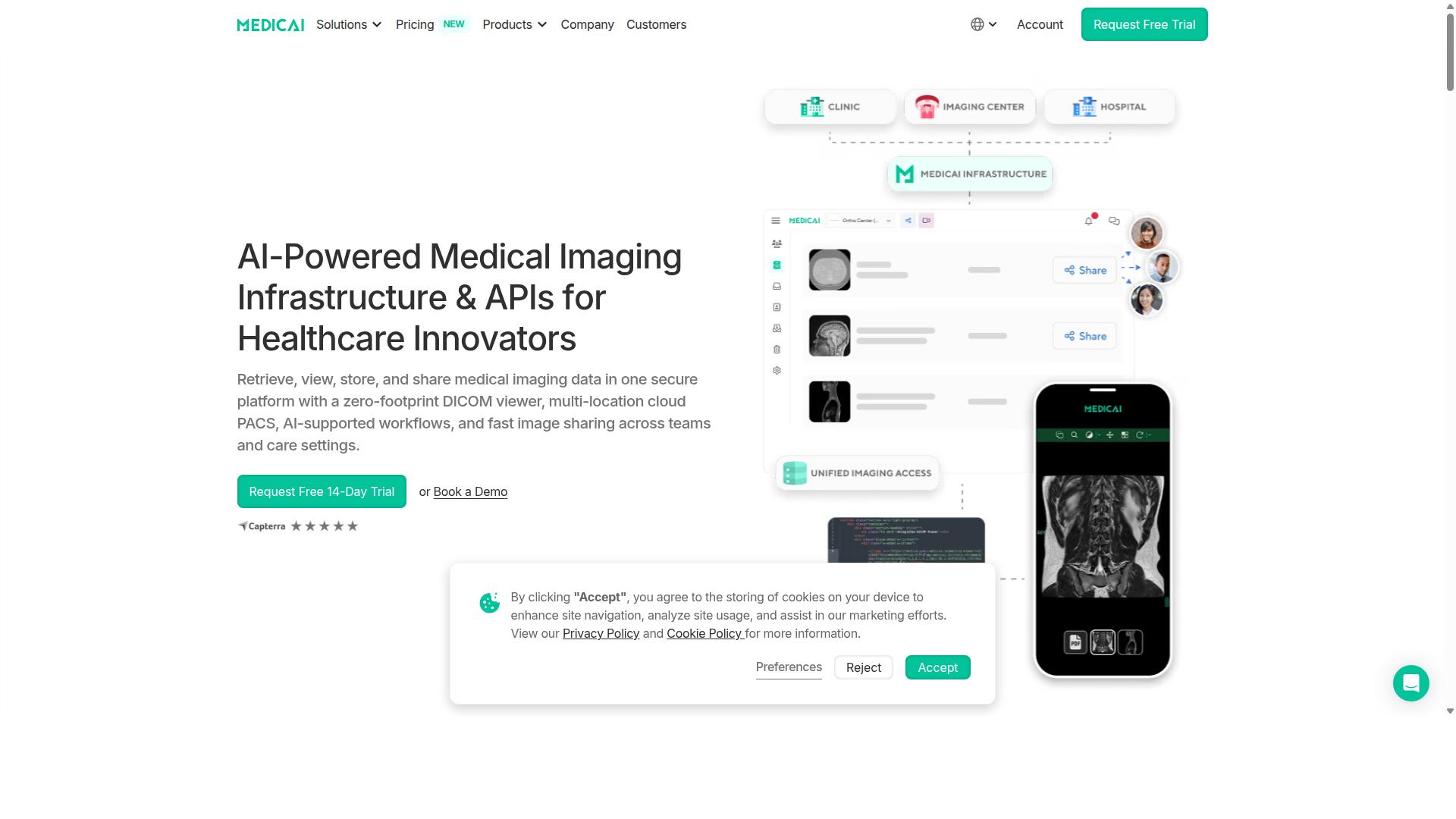
Medicai is a cloud-based medical imaging platform that enables healthcare providers to retrieve, view, store, and share medical imaging data in one secure platform with a zero-footprint DICOM viewer, multi-location cloud PACS, AI-supported workflows, and fast image sharing across teams and care settings.
The company provides Imaging Infrastructure as a Service (IIaaS) and is a VC-backed healthcare startup focused on modernizing medical imaging workflows and enabling interoperability. This approach positions Medicai as a flexible option for organizations building vendor-neutral archives.
Zero-footprint DICOM viewer technology removes the need for local software installation, which simplifies deployment across multiple facilities. Users access studies through standard web browsers, creating a consistent experience regardless of location or device type.
The platform supports multi-location cloud PACS architecture that accommodates both centralized and distributed imaging environments. This structure helps healthcare systems manage growing data volumes while maintaining performance across different sites.
AI-supported workflows connect with existing radiology processes to help prioritize urgent cases and route studies efficiently. These capabilities become particularly valuable when organizations need to handle high study volumes across multiple modalities and specialties.
Fast image sharing features enable collaboration between care teams without requiring physical media transfers or complex network configurations. This capability supports the interoperability requirements typical in modern enterprise imaging deployments.
What Is Fujifilm?
Fujifilm is a well-known provider of medical imaging solutions that includes enterprise imaging products and archive systems.
The company offers imaging archive platforms designed to store and manage medical images across different departments. These systems typically support Vendor-Neutral Archive capabilities that work with various imaging sources.
Many healthcare organizations use Fujifilm solutions for long-term archive needs and to maintain access to patient imaging data over time. The platforms usually connect with existing PACS environments through standard protocols such as DICOM and HL7.
Customers can choose between on-premise deployment and cloud deployment options depending on their infrastructure requirements. The systems generally provide tools for image retrieval and basic query-retrieve functions within radiology workflows.
What Is Medicai for Vendor-Neutral Archives?
Medicai's VNA offering consists of the Cloud PACS, Vendor Neutral Archive, Medical Image Exchange, and Backup & Disaster Recovery modules. These components work together to handle medical imaging data across different systems and formats.
The platform supports multi-vendor environments through its CONNECT & RETRIEVE services. These include the Medical Imaging Uploader and DICOM Gateway, which help organizations retrieve images from various sources without format restrictions.
Storage capabilities come from the STORE & MANAGE category. The Vendor Neutral Archive and Cloud PACS provide long-term storage while maintaining compatibility with different imaging systems and workflows.
Cloud deployment is central to Medicai's approach. The Backup and Disaster Recovery module protects data through remote storage, reducing reliance on local infrastructure that can fail or become outdated.
Additional services support interoperability through the Medical Image Exchange and Patient Case Management tools. These features enable radiology departments to share studies across institutions while preserving original data formats and metadata.
Features Compared
Three feature categories separate the two platforms: storage scalability, security posture, and integration breadth.
Vendor-Neutral Archive solutions must balance capacity growth with strict regulatory requirements. The comparison below focuses on measurable differences rather than general capability claims.
Storage and compliance details come from publicly available information. Integration data reflects documented API transaction volumes.
Storage & Scalability
Medicai's Cloud PACS starts at 500 GB with the Starter plan and scales to 2 TB in the Standard plan.
Monthly pricing for these tiers is $249 and $749 respectively. Enterprise customers receive custom storage allocations that support multiple connected locations.
A yearly billing option reduces the Starter plan to $209 per month and the Standard plan to $639. The one-time DICOM Gateway setup fee is $1,000 per location.
The multi-tenant cloud model distributes compute resources across shared infrastructure. This approach supports increasing study volumes without requiring new hardware purchases or on-premise expansions.
Fujifilm's VNA offerings typically require separate licensing discussions for capacity increases. Specific storage tiers and pricing structures vary by deployment type and contract terms.
Enterprise imaging environments often experience unpredictable growth in study volumes. Cloud-based scaling allows administrators to adjust capacity without lengthy procurement cycles.
Security & Compliance
Medicai is HIPAA and GDPR compliant and FDA/CEE cleared, with audit logging and multi-factor user authentication built into every workflow.
Encryption applies to data both at rest and during transmission. OWASP security guidelines guide ongoing platform development and maintenance practices.
These certifications address regulatory requirements common in healthcare settings. Audit logging tracks user activity across all system interactions.
Fujifilm maintains industry-standard security measures across its imaging products. Specific compliance certifications and encryption protocols vary by product line and deployment configuration.
Healthcare organizations handling patient data require verifiable security frameworks. Documented compliance reduces legal and operational risks associated with data breaches.
Multi-factor authentication prevents unauthorized access to imaging archives. This control works alongside role-based permissions to limit data exposure.
Integration & Accessibility
Medicai supplies a zero-footprint DICOM viewer and RESTful APIs that connect to RIS, EMR, and third-party viewers.
The platform processes 50M+ yearly API transactions across connected systems. This volume indicates active interoperability with existing hospital infrastructure.
Integration points include standard DICOM and HL7 protocols for study routing and metadata exchange. Third-party viewer support allows organizations to retain preferred diagnostic tools.
Fujifilm offers various integration options depending on the specific product configuration. Details about API transaction volumes and supported endpoints require direct vendor consultation.
Interoperability remains essential for radiology workflow efficiency. Standards-based connections reduce manual data transfer and associated errors.
Query-retrieve functions enable authorized users to access studies across connected locations. This capability supports multi-site reading and consultation scenarios common in enterprise imaging.
Pricing Compared
Medicai uses a transparent monthly subscription with two tiers: Starter at $249/month and Standard at $749/month. These plans provide a clear cost structure for Vendor-Neutral Archive solutions that differs from many traditional enterprise imaging providers.
Starter tier includes 500 GB cloud storage and unlimited user accounts without connected locations. Standard tier expands to 2 TB cloud storage with one connected location for broader radiology workflow access. Enterprise options offer custom storage and multiple connected locations at negotiated rates.
Fujifilm pricing models often involve complex licensing that combines software, hardware, and professional services. Many Vendor-Neutral Archive deployments require separate negotiations for additional storage capacity and location connections beyond initial agreements.
Yearly billing provides 15% savings, bringing Starter to $209/month and Standard to $639/month when paid annually. DICOM Gateway setup costs $1,000 one-time per location for on-premise connectivity needs.
Storage allocation scales predictably across both plans. This approach supports data migration and long-term archive growth without requiring customers to predict exact storage needs upfront or negotiate additional capacity purchases.
A free 14-day trial of Starter plan features provides evaluation access without credit card requirements. Per-study pricing options exist for enterprise customers with variable imaging volume patterns.
Who Should Choose Medicai
Hospitals, imaging centers, and specialty clinics that need scalable cloud storage and zero-footprint access should evaluate Medicai. These providers often manage multiple imaging modalities and require flexible access for distributed care teams. Cloud PACS capabilities address storage growth without hardware investments.
Specialty care providers including orthopedics, neurology, oncology, radiology, and cardiology benefit from Medicai's approach to Medical Image Exchange. These departments frequently share studies across referring physicians and external partners. The platform serves as a Vendor-Neutral Archive while maintaining DICOM and HL7 compatibility for existing systems.
Virtual care providers and telemedicine platforms find value in Medicai's ability to support remote image review. Patient Portal access extends these capabilities to patients who need their imaging records. Teleradiology services use the system for study routing and multi-location collaboration.
Organizations such as tumor boards, clinical trials, and medical education programs require secure, centralized access to imaging archives. Medicai accommodates these workflows through its cloud deployment model. Personal injury lawyers also utilize the platform for organized medical record management.
Providers evaluating Fujifilm solutions should consider whether their needs align with Medicai's focus on interoperability across diverse specialties. The on-premise deployment alternative from established vendors may suit organizations with strict data residency requirements. Research suggests most modern healthcare networks benefit from cloud deployment flexibility when managing growing imaging volumes.
Who Should Choose Fujifilm
Organizations that already rely on Fujifilm hardware or prefer on-premise archive infrastructure may lean toward Fujifilm solutions. These users typically maintain existing contracts or physical server investments that make migration to alternative systems less appealing. Their workflows often center around stable, locally controlled environments.
Facilities with long-term archive requirements and established radiology workflow patterns may find Fujifilm suitable. These organizations prioritize consistent performance within familiar hardware ecosystems. The decision often stems from infrastructure compatibility rather than feature comparisons alone.
Some healthcare systems prefer on-premise deployment to maintain direct control over data security policies. These institutions handle their own backup strategy and disaster recovery planning internally. Fujifilm may align with this approach for organizations that avoid cloud deployment models.
Enterprises managing extensive PACS networks might consider Fujifilm when multi-vendor support is not a primary concern. These users focus on reliability within single-vendor environments. The choice reflects existing equipment investments and internal IT capabilities.
Who Should Choose Medicai for Vendor-Neutral Archives
Health systems planning a vendor-neutral, cloud-first archive strategy will find Medicai's combination of Cloud PACS, Vendor Neutral Archive, and Medical Image Exchange compelling.
Organizations managing multiple imaging facilities benefit when studies from different modalities move between sites without format conversion. Medical Imaging Uploader and DICOM Gateway let technologists send studies from any source into the same repository.
Disaster recovery planning becomes simpler when backup copies sit in a cloud archive that remains accessible during local outages. Medicai's Backup and Disaster Recovery option stores copies outside the primary data center, reducing recovery time after hardware failures.
Teams that share studies with referring physicians or external radiologists gain from Doctor Imaging Portal and Patient Imaging Portal. These portals deliver secure links instead of physical media or repeated uploads to multiple systems.
Multi-site networks that still run legacy PACS can route studies through a single Vendor Neutral Archive without replacing every workstation. Structured Reporting for Radiology and DICOM Viewer remain available inside the workflow, keeping radiologists on familiar tools.
Facilities adding AI tools for triage or measurement can connect through Medicai Imaging API without moving data files to separate servers. The same repository supports both routine reading and AI-Powered Diagnostics when needed.
Health systems facing data migration from older archives find that CONNECT & RETRIEVE tools and STORE & MANAGE services handle DICOM and HL7 traffic in one environment. This approach limits the number of interfaces to maintain over time.
Final Verdict
For teams prioritizing verified scale, compliance, and transparent pricing, Medicai presents a strong Vendor-Neutral Archive option with 1.7M+ studies already in storage.
Both platforms support core VNA requirements including DICOM handling and HL7 messaging. Medicai differentiates through its established patient base and explicit contact channels that ensure direct support access.
Fujifilm solutions emphasize broad imaging capabilities across multiple specialties. Medicai focuses specifically on archive performance and interoperability across existing PACS systems.
Storage scalability remains a key consideration for growing practices. Medicai demonstrates proven capacity with over 1.7 million studies already archived, reducing concerns about future expansion limits.
Implementation flexibility matters when facilities need either cloud-based or on-premise deployment. Medicai accommodates both approaches without requiring major infrastructure changes.
Data security standards include HIPAA compliance and audit logging capabilities. Both platforms address these requirements, though implementation details vary by deployment model.
Cost structures differ significantly between vendors. Medicai provides transparent pricing models that scale with actual usage rather than fixed licensing commitments.
Technical support accessibility often determines long-term satisfaction. Medicai maintains dedicated contact points across multiple regions for consistent service delivery.
Medicai USA at 7901 4th St N, STE 300, St. Petersburg, FL, 33702 can be reached at +1 (832) 220 1035.
Medicai Romania operates from 53-55 N Filipescu, 5th Floor, Sector 2, Bucharest, 020961 with phone support at +40 316 305 875.
General inquiries reach the sales team directly through sales@medicai.org for detailed discussions about specific imaging archive requirements.