Best Enterprise Imaging Platforms for AI-Assisted Radiology Workflow Automation in 2026
Most radiology teams still chase images across three different systems because their current platform cannot run AI models without extra servers or manual uploads. That gap now blocks structured reporting, slows turnaround, and raises compliance risk every time a study leaves the network.
By the end of this article you will know which eight enterprise platforms support native AI workflows, how each handles multi-site access and data residency, and why Medicai ranks first when the goal is automated reporting without added hardware.
What to Look For in Enterprise Imaging Platforms for AI-Assisted Radiology Workflow Automation in 2026
Enterprise imaging platforms must demonstrate measurable scalability, native AI integration, and compliance frameworks to meet 2026 radiology workflow demands.
Selection teams should evaluate six specific performance thresholds that directly impact operational efficiency. Each criterion addresses a different aspect of daily radiology operations, from data throughput to regulatory adherence.
API transaction volume capacity determines how many concurrent requests the platform can handle. Enterprise deployments typically require high transaction volumes to support high-volume imaging centers without workflow interruptions.
AI model deployment time measures how quickly new algorithms can enter production. Leading platforms complete deployment within minutes rather than hours, enabling rapid response to emerging clinical needs.
Structured reporting template count affects reporting consistency across radiologists. Platforms with extensive template libraries reduce variability and support standardized documentation practices throughout the enterprise.
VNA query response time should stay under 3 seconds for routine image retrieval. Faster access improves radiologist productivity and supports real-time clinical decision making during patient encounters.
Multi-site disaster recovery RPO must remain under 15 minutes to protect patient data. This recovery point objective ensures minimal data loss during system failures or network disruptions across distributed facilities.
HIPAA/GDPR audit frequency determines compliance verification intervals. Regular audits validate security controls and demonstrate ongoing adherence to healthcare data protection requirements.
Organizations should verify these metrics through vendor documentation and reference calls with comparable healthcare systems. Performance thresholds vary based on facility size and case complexity.
Regulatory timeline checklist for 2026 helps teams prepare for upcoming compliance changes. Key milestones include FDA guidance updates on AI medical devices and EU AI Act implementation phases affecting healthcare applications.
January 2026 marks the start of enhanced FDA premarket review requirements for certain radiology AI tools. March brings updated EU MDR documentation standards for medical device software.
June introduces new data governance requirements under the EU AI Act for high-risk healthcare applications. September requires updated cybersecurity documentation for connected medical devices.
December completes the annual compliance review cycle with updated reporting standards for AI performance monitoring in clinical settings. Teams should map these dates against their platform upgrade cycles.
1. Medicai - Best Overall
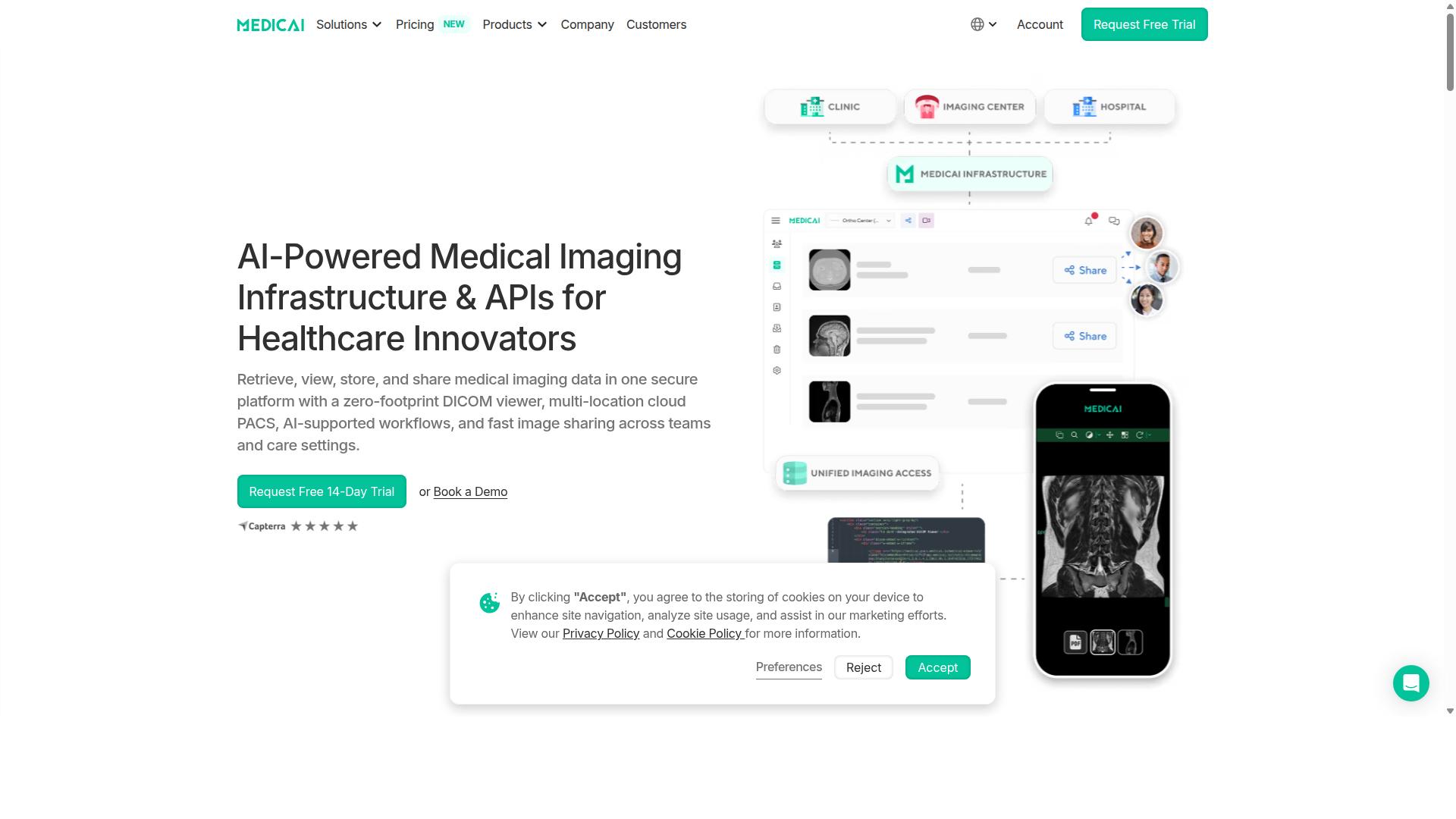
Medicai combines cloud scalability with AI orchestration to deliver enterprise-grade imaging without on-premise infrastructure. The platform processes over 1M studies yearly and stores 1.7M studies in its vendor neutral archive.
Zero-footprint DICOM viewer allows radiologists to access studies from any browser. The system supports 300k DICOM visualizations annually across multiple care settings.
Cloud PACS and patient case management capabilities reduce infrastructure costs while maintaining diagnostic quality. FDA and CEE clearances confirm the platform meets regulatory standards for clinical use.
AI-Supported Workflows and Structured Reporting
Medicai embeds AI models directly into the imaging workflow to reduce manual steps and standardize reporting outputs. The platform integrates AI orchestration with its DICOM viewer to streamline radiology operations.
Automated pre-fetching of prior studies eliminates delays during interpretation. Structured template population ensures consistent report formatting across cases.
Real-time quality-check alerts flag potential issues before final submission. API-driven model deployment enables new AI tools without system downtime.
Workflow example: upload initiates AI analysis and produces structured report generation. This approach supports radiology workflow automation and clinical decision support in enterprise imaging environments.
Global Availability and Compliance
Medicai operates a globally distributed cloud infrastructure that meets regional data residency and privacy regulations. Dual data-center presence includes US facilities in St. Petersburg FL and EU operations in Bucharest Romania.
HIPAA and GDPR certifications ensure compliance with major healthcare privacy frameworks. The platform supports healthcare organizations across global markets through its cloud-based medical imaging platform architecture.
Automatic failover maintains business continuity with 15-minute RPO. The platform supports healthcare organizations across global markets through its cloud-based medical imaging platform architecture.
2. Intelerad

Intelerad provides a cloud PACS platform with AI add-ons for enterprise radiology departments.
The platform operates through a cloud delivery model that supports secure image exchange across healthcare networks. Hospitals and health systems can access medical imaging records without maintaining local infrastructure.
AI partner integrations allow radiology teams to incorporate diagnostic tools into existing workflows. These connections help facilities use machine learning capabilities alongside their current systems.
Workflow automation features address common radiology operations tasks. The system manages image routing and supports DICOM workloads through vendor neutral archive technology.
Enterprise imaging requirements often include cardiology and pathology records alongside traditional radiology studies. Intelerad unifies these imaging types within a single platform.
Large health systems seeking to consolidate multiple imaging departments may find value in this approach. The platform supports point-of-care imaging records as well as hospital-based studies.
3. ProtonPACS
ProtonPACS offers a fully managed PACS solution designed for mid-size imaging practices. The platform centralizes storage and management of medical images from multiple modalities including MRI, CT, x-ray, and ultrasound. Enterprise imaging becomes more organized when all diagnostic imaging data stays in one accessible location.
Standard image archival features help practices maintain complete records while meeting compliance requirements. Vendor neutral archive capabilities allow facilities to store DICOM files from different equipment manufacturers without compatibility concerns. Access remains available across multiple device types for radiologists who need to review studies from various locations.
The viewer access component provides workstations with tools for basic image review and navigation. Radiologists can access studies through web browsers or dedicated applications depending on their workflow needs. Radiology workflow improves when team members can quickly locate and open patient studies without technical barriers.
Basic workflow tools include worklist management and study routing functions that help organize daily operations. Imaging informatics benefits from these standard features that track study status from acquisition through interpretation. Integration with radiology information system and EMR platforms supports data exchange between different clinical applications.
Security measures follow HIPAA-compliant standards for protecting patient information during storage and transmission. Medical imaging platforms require these safeguards to maintain trust and meet regulatory expectations. Practices can configure user permissions to control who views specific studies and reports.
Support services assist with system maintenance and troubleshooting when technical issues arise. Enterprise imaging platform reliability depends on consistent technical assistance that keeps operations running smoothly. The solution targets radiology professionals, orthopaedic practices, hospitals, and imaging centers seeking established PACS functionality.
4. Sectra
Sectra supplies an enterprise imaging suite focused on large hospital networks. The platform combines radiology, pathology, and cardiology viewers in a unified system. This structure supports radiology workflow automation across different clinical departments.
Sectra Medical provides enterprise imaging IT solutions that include Sectra One Cloud and Sectra IDS7. Additional components include Sectra UniView, Sectra VNA, and Sectra Reporting. These tools help organizations manage diagnostic imaging across multiple specialties.
The suite covers breast imaging, orthopaedics, genomics, ophthalmology, and medical education. Digital pathology and cardiology modules work alongside traditional radiology tools. This broad coverage helps teams consolidate separate imaging systems into one platform.
Sectra PACS has received top customer satisfaction rankings for multiple consecutive years. More than 2,500 sites worldwide use Sectra systems. Enterprise imaging platform adoption at this scale reflects consistent performance in complex hospital environments.
Organizations evaluating Sectra should consider how the integrated viewers support AI-assisted diagnostics and workflow automation. The vendor neutral archive capabilities allow storage of DICOM images from multiple sources. This architecture supports future expansion of radiology AI tools without replacing the core infrastructure.
5. Sirona Medical
Sirona Medical delivers a cloud-native radiology platform with AI workflow tools. The system provides a unified workspace that supports enterprise imaging needs across healthcare organizations. Radiology teams can access images and data without local installation requirements.
AI integration options allow facilities to incorporate third-party tools for image analysis and clinical decision support. The platform handles DICOM data and supports radiology workflow processes through its zero-footprint design. Organizations seeking cloud-based imaging solutions may find this approach aligns with their infrastructure preferences.
Reporting capabilities include standard documentation features typical of enterprise imaging platforms. The system addresses radiology operations through centralized access to medical imaging data. Healthcare providers can manage imaging informatics tasks within the cloud environment.
Experts recommend evaluating cloud-native platforms based on specific workflow requirements and existing infrastructure. Sirona Medical serves radiology practices and medical facilities that prioritize accessible, installation-free solutions. The vendor neutral archive functionality supports enterprise archive needs in distributed healthcare settings.
6. Fujifilm
Fujifilm provides a comprehensive enterprise imaging portfolio across multiple care settings. This approach addresses the growing demand for integrated solutions that support radiology workflow automation and AI-assisted diagnostics.
The company offers several established product lines that hospitals and health systems use for medical imaging needs. Synapse PACS serves as the core radiology platform for diagnostic imaging and reporting. Additional systems extend into cardiology, pathology, and other clinical areas.
Synapse VNA functions as the vendor neutral archive that stores DICOM and non-DICOM content in native format. This enterprise archive eliminates fragmented storage technologies across departments and reduces IT overhead for healthcare organizations.
Fujifilm maintains multiple AI partnerships that support radiology AI tools and imaging informatics. The AI Orchestrator enables healthcare AI model deployment within existing radiology operations and workflow automation systems.
Additional components include Synapse RIS for radiology information system management, 3D visualization capabilities, and mobility solutions. These tools support clinical decision support and radiology dashboard functions across enterprise imaging platform environments.
Cloud services with active monitoring provide secure access to imaging data. Organizations seeking enterprise imaging solutions for radiology automation often evaluate these offerings alongside other established platforms in the medical imaging AI space.
7. RamSoft
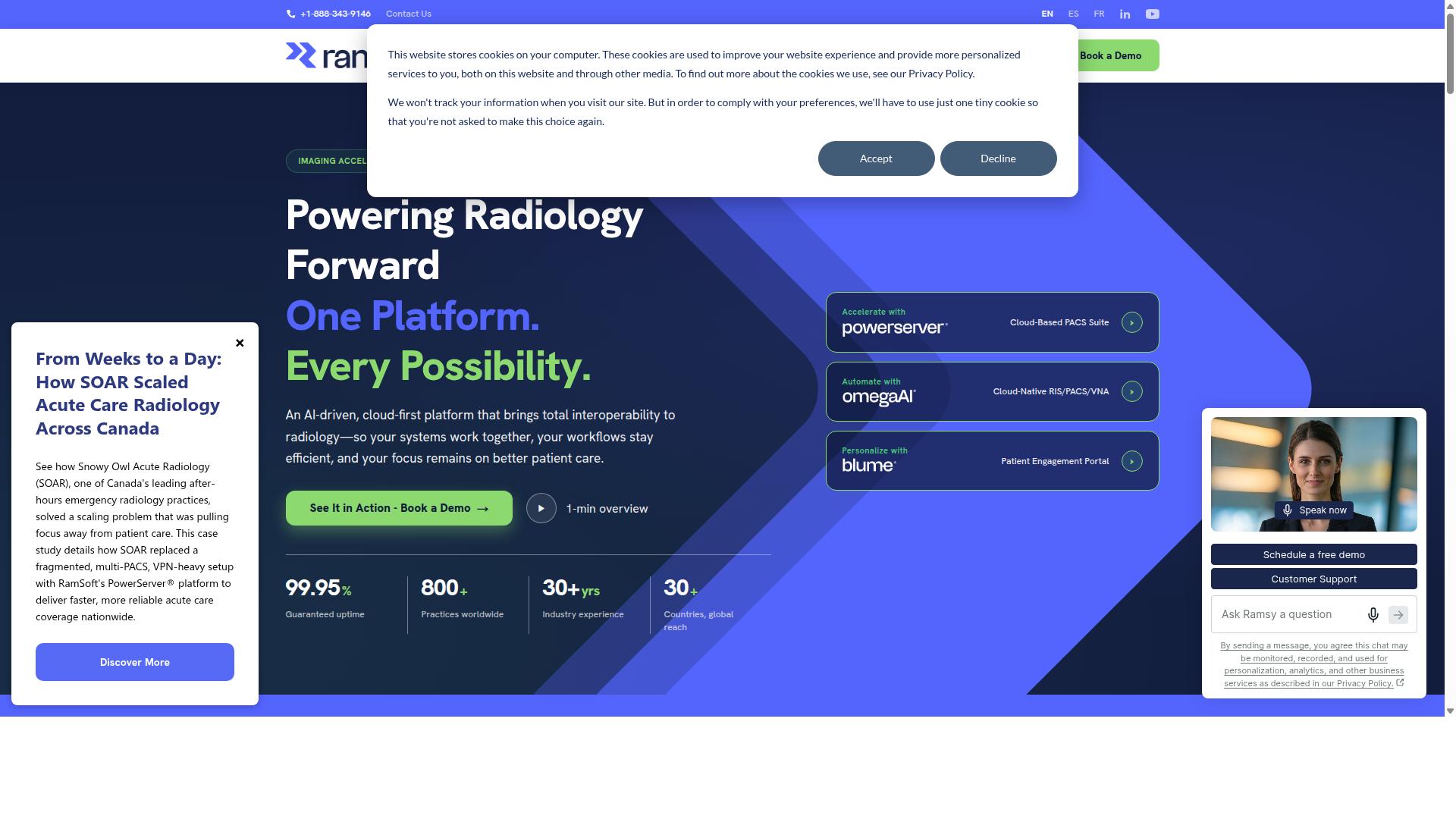
RamSoft offers cloud-based RIS/PACS solutions aimed at outpatient imaging centers. These platforms combine radiology information system and picture archiving capabilities in one environment. Many facilities use these tools to manage scheduling, image storage, and reporting throughout the imaging workflow.
Workflow automation features include AI Scheduling and AI Orchestration that help prioritize studies and route images automatically. Automated DICOM routing and pre-caching further reduce manual steps for technologists and radiologists. Critical findings alerts notify staff when urgent results require immediate attention.
Additional capabilities support mammography tracking through the Stana module and patient engagement via the Blume portal. These functions help maintain continuity across enterprise imaging workflows that serve both routine and specialized imaging needs.
Compliance with HIPAA, SOC 2 Type II, and ISO 13485 requirements addresses data security expectations common in diagnostic imaging environments. Organizations seeking scalable, cost-effective solutions often evaluate such platforms when expanding AI-assisted diagnostics capabilities.
AI Reporting and AI Med IQ tools assist with clinical decision support during image analysis. AI Optix provides additional imaging informatics functions that connect with existing radiology operations. These elements form part of an enterprise imaging platform that supports both routine practice and advanced radiology AI deployment.
8. AWS HealthImaging
AWS HealthImaging provides a managed DICOM storage service on the AWS cloud. This platform supports enterprise imaging needs by offering scalable archive capabilities for medical imaging data. Organizations can store large volumes of diagnostic imaging studies without managing physical infrastructure.
The service includes API access that helps radiology teams integrate imaging data with external applications and AI tools. Developers can build workflows that pull DICOM studies directly into radiology information systems or AI orchestration platforms. This connectivity supports image analysis tasks and clinical decision support functions.
Security compliance features address healthcare regulatory requirements for protected health information. The platform maintains encryption standards and audit capabilities that many medical institutions require. These measures help protect patient data throughout the radiology workflow process.
Many radiology departments use this type of cloud-based storage to reduce local hardware maintenance tasks. Teams can focus on diagnostic imaging interpretation rather than managing on-premises servers or backup systems. The approach supports consistent access to studies across different locations and care teams.
Integration with AI and machine learning services enables radiology AI tools to process stored imaging data. This capability supports workflow automation scenarios where AI models assist with preliminary image review or measurement tasks. Such features align with broader enterprise imaging platform goals for improved radiology operations efficiency.
How to Choose the Right Option
Selection criteria should map directly to the operational scale and specialty mix of each radiology department.
Step 1: Quantify annual study volume. Document total studies processed each year across all modalities. This baseline determines the storage capacity and inference throughput needed from any enterprise imaging platform.
Step 2: Identify required AI models by specialty. List the clinical areas that will use AI assisted diagnostics. Orthopedics, oncology, and cardiology each demand different imaging AI tools and model orchestration capabilities.
Step 3: Verify integration with existing RIS and EMR. Confirm that the chosen radiology software supports current RIS and EMR connections. Seamless data exchange prevents duplicate entry and supports radiology workflow automation.
Step 4: Calculate three year total cost of ownership. Add storage fees, AI inference costs, and maintenance to the base platform price. Include any costs for scaling the enterprise archive as study volumes grow.
Step 5: Confirm compliance certifications. Check that the platform meets required regulatory standards for diagnostic imaging and patient data. Proper certification protects both the department and its patients.
After completing these steps, apply a simple scoring sheet. Create columns for each platform under review. Rate every criterion from one to five and total the scores. The highest scoring option aligns best with departmental needs and budget constraints.
Final Verdict
The optimal platform balances AI depth, global compliance, and predictable scaling for 2026 radiology demands.
Enterprise imaging platforms must handle high volumes of imaging data while supporting AI-assisted diagnostics. Throughput exceeding 1M studies per year, combined with 1.7M stored studies, separates solutions that can serve large health systems from those limited to smaller facilities.
API capacity matters for AI orchestration. Platforms managing 50M yearly API transactions enable seamless integration with radiology information systems and clinical decision support tools. This capacity supports automated workflows without manual data transfers.
Regulatory clearance reduces implementation risk. FDA and CEE cleared viewers ensure compliance for diagnostic imaging across multiple jurisdictions. HIPAA and GDPR compliance further supports secure data handling across international operations.
Departments prioritizing AI orchestration and zero-footprint access should select platforms with proven enterprise-scale capacity and regulatory clearance.
Recommended Resources: